
The Global GOES Market Topped 4.6 Million Metric Tonnes In 2024, 76% Higher Than Just Five Years Ago; Conversely, The USA GOES Market Has Dropped 11% Over The Past Six Years
December 7, 2025
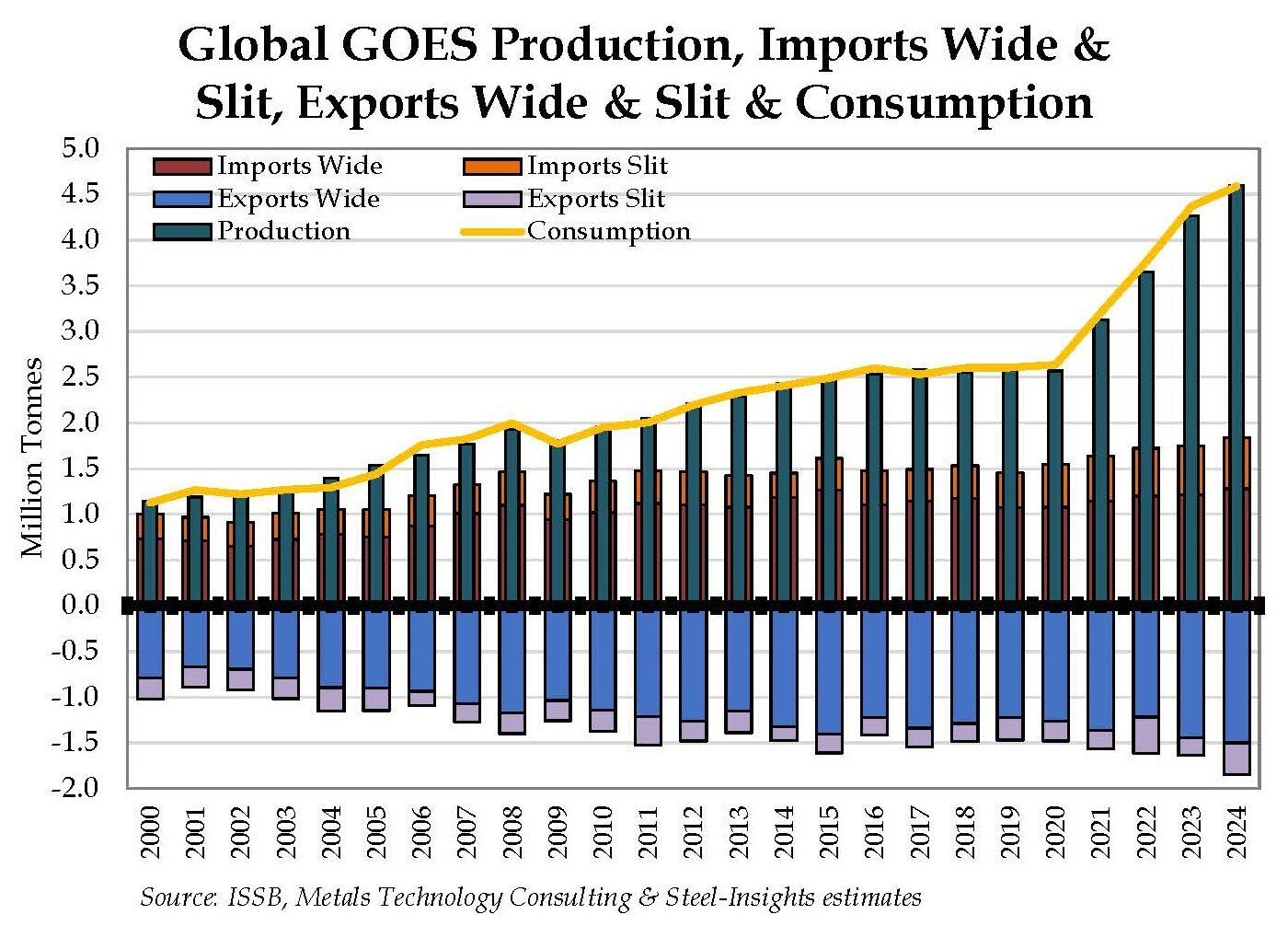
The US grain-oriented electrical steel (GOES) market was fairly balanced between production and consumption from the early 2000’s at the 200-250 thousand tonne level, but inconsistent domestic supply at uncompetitive domestic prices coupled with hostile trade policies on imports drove the users of transformer steels out of the USA, mainly to Mexico and Canada. By 2008, consumption had dropped by 55% at the trough and exports soared north of 215 thousand tonnes. The market recovered to a peak 263 thousand tonnes in 2018, followed by four declining years that took the market down by 14%. We estimate USA consumption was 234 thousand tonnes in 2024. Over the same time period from 2018 (a down year globally) to 2024, the global GOES market grew 80%, adding 2 million tonnes to production/consumption. (NOTE: GOES is produced to order with production essentially equaling consumption. There are some minor amounts in transit resulting in some imbalance in the system, but typically it’s less than 5%). The market is supplied 65% from China, 12% from Japan, 5% from Russia, 3% from South Korea and 3% from the USA. Mill utilization in 2024 was estimated at 85% overall, and 87% in the higher transformer grades. The product mix continues to shift to higher grade products with 66% transformer grade products and 34% in the lower “regular” grade in 2024. (Note: The product mix a decade ago in 2015 was 48% transformer grade products and 52% regular grade products.) Based on our market consumption analysis, we predict that the shift will continue to higher grade products and that demand in regular grades will drop to just one-fourth of the market by 2035.
According to market sources, the sole US based electrical steel producer’s mix was 33% higher grade products and 67% regular grade products. Despite the lackluster USA performance, North American consumption grew 27% over the past decade as transformer intermediary products such as laminations, standard core and wound core production stayed close to home, shifting to Canada and Mexico where the electrical steel was available and affordable. Based on our analysis, distribution transformers account for just over half of the North American demand for GOES with the conversion split being 43% in the USA, 37% in Mexico and 20% in Canada. The second largest market is power transformers accounting for 20% of North American consumption, split 57% in the USA, 28% in Mexico and 15% in Canada. We estimate that two-thirds of GOES “imports” into the USA come in as intermediary products accounting for 87% of the GOES exports from Mexico and 79% of the GOES exports from Canada. Transformer production in the US has been limited by an inadequate supply of domestically produced electrical steel. We commend the sole US based supplier for its commitment to supplying the transformer market. We are thrilled by the Nippon announcement that it will add transformer steel production at its USS/BRS mini-mill in Arkansas. (Note: We prepared the banking report for the addition of electrical steels to this mill and it’s very satisfying to see that vision becoming reality.) That being said, these capital investment projects are relatively expensive and require long lead times to come to fruition and full commercialization. We’ve personally pitched MANY sheet producers in the US and Europe to add these steels to their product offerings and while the demand is compelling and the interest is there, constructing a workable project that will pass a ROI committee is more challenging.
Here are the facts:
- We need more USA based electrical steel production, that takes 3-5 years to bring into operation.
- We need more USA based transformer and intermediary transformer products production, which is currently constrained by a lack of available high-grade supply of electrical steel.
- The lack of both represents a critical threat to national security and we believe could ultimately limit the growth projected for required electricity if the government doesn’t intervene with grants, subsidies and/or other financial stimuli to incentivize these investments.
- We’ve seen the results in the numbers. Not only is the USA not able to participate in the global growth in transformer production, but we’re approaching a time when we won’t even be able to supply our own internal demand.
Our analysis and conclusions come from a proprietary global by mill by product production model, a proprietary by country production adjusted for trade consumption model, and now a second proprietary by country by market consumption model. (Note: Based on our industry experiences, we adjust the trade data to reflect the consumption by country that we’ve been able to verify through our market contacts (including both production and consumption participants), making the results more “real” rather than academic.)
We have experience preparing board level analysis in an easy to comprehend and data defended manner. We know where the steel is made, by whom, shipped to where (only a small percentage of electrical steel is consumed in the country its produced) and used by whom and for what.
For more information, please don’t hesitate to contact the principles of The Core Coalition, Metals Technology Consulting or Steel-Insights, LLC.
0 Comments